
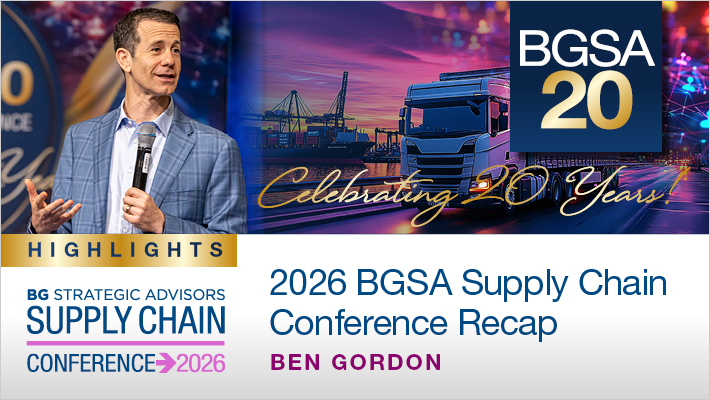
On behalf of all of us at BGSA Holdings and Cambridge Capital, we wanted to share some highlights of BGSA Supply Chain 2026. For those of you who joined us, we hope you had a great time.
For our 20th annual Supply Chain conference, we returned as always to the Breakers in Palm Beach. We enjoyed the warmth of a truly special supply chain community, and hosted an all-time high of 440 CEOs and leaders across all areas of the supply chain ecosystem.
This record turnout included CEOs from North America, South America, Europe, Asia and Africa. We got to exchange ideas with leaders in logistics, distribution, freight forwarding, truck brokerage, warehousing, trucking, shipping, last mile, fulfillment, and other areas. As technology has become more and more embedded in the supply chain, we met with AI and software all-stars in WMS, TMS, reverse logistics, predictive pricing, digital brokerage, and a host of ecommerce logistics categories. We got to talk with over 30 of the top supply chain CEOs about their outlook for 2026. And we had some special guests, including a surprise town hall conversation with supply chain legend Brad Jacobs, who has founded and run seven multi-billion-dollar companies. This was truly a "Davos for Logistics" week!
Why Do So Many CEOs Join the BGSA Supply Chain Conference?
BGSA is a source of unique community. For 20 years, the top leaders have gathered to discuss ideas, build relationships, and pursue growth. It is also the place where top people make top moves to achieve success. Over the last 20 years, CEOs have forged more than $20 billion worth of transactions here, ranging from high-profile combinations like Uber-Transplace to WiseTech-Envase to Triumph-Greenscreens to many others. Founders have raised capital, won customers, and achieved growth on the back of winning the BGSA Supply Chain Shark Tank, like Venti, SecurSpace (now WiseTech), AutoScheduler.ai and others. CEOs have hired senior talent here. And much more.
What Did We Learn?
2026 is shaping up to be a crucial year to make top moves. We at BGSA and Cambridge believe we are facing an inflection point. We believe we are about to enter the fourth major wave of change in the modern supply chain world.
• The first wave began in 1956, when Malcom McLean invented the modern shipping container, revolutionizing global trade
• The second wave emerged in 1980, when the Motor Carrier Act of 1980 ushered in an era of deregulation, outsourcing, and competition
• The third wave developed in 1997, when Amazon went public and the Internet age began, transforming supply chain efficiency through digital networks
• The fourth wave is upon us: the age of AI.
AI: The New Frontier for Supply Chains
In a year when the Great Freight Recession continued to constrain transportation companies, the public companies in the BGSA Supply Chain Truckload index treaded water (up 2.1% in market value). The LTL index declined 12.3%. And at a time when the majority of the publicly-traded logistics companies declined in value (in one case by as much as 65%), one truck broker shot up 57%: CH Robinson.
How did they do it? A key driver was AI. CH Robinson invested heavily in AI. They deployed over 400 engineers, built over 30 agents, and started by automating key processes. For instance, they found that they were only covering 60% of all quote requests, due to the high volume of email-based inbound messages. And they were taking an average of 20 minutes per message to respond. Through AI, they were able to respond to 100% of all requests, and they slashed average response time down to 30 seconds. The payoff was clear. In a market where many competitors struggled and some went bankrupt, CH Robinson figured out how to boost their margins. And they were rewarded by the public markets.
CH Robinson wasn't the only winner. If you look across the 60 publicly-traded companies in the BGSA Supply Chain Index, in aggregate the market was up 7%. But the dispersion of winners and losers was extremely broad. In healthcare distribution, companies like Cardinal Health found "riches in niches," shifting to high-margin services like specialty and at-home delivery. In rail, the Norfolk Southern-Union Pacific merger represented an $85 billion consolidation that would create America's first transcontinental railroad. And in logistics, CH Robinson and Expeditors led the way.
The name of the game in 2026 is AI. Since ChatGPT's launch in Q4 2022, had you invested in the "AI Index," you would have outperformed the rest of the market by 7x (195% vs 26%). As a Stanford survey of 2,854 executives shows, AI's biggest immediate impact lies in supply chain: more than 60% have already realized supply chain cost savings from generative AI — greater than in any other corporate function. A Prologis survey of 1,816 executives showed that AI represents the #1 capital expenditure for supply chain companies in 2026. And venture capitalists allocated 55% of all new supply chain investment into AI companies.
What Decisions to Make?
We believe 2026 represents an inflection point. On the one hand, markets are buffeted by volatility. Will the tariff shocks of Liberation Day give rise to supply chains that are more localized? Will AI automate broad swathes of the economy, reshaping industries and reallocating capital, margins and value from incumbents to challengers? And will the Great Freight Recession finally end? On the other hand, we see greater opportunity than ever before. For winners, the path to success has never been faster or more rewarding. 2026 may well be a "Fork in the Road" with enormous implications.
Cambridge Capital
At Cambridge Capital, we believe we are in the early innings of high-growth digital supply chains as well as compressed supply chains. Key themes include AI to automate supply chains, supply chain visibility, reverse logistics, and tech-enabled "man + machine" services. Our investments include Greenscreens.ai (sold to Triumph), Parcel Perform, Bringg, ReverseLogix, Liftit, DeliveryCircle, and STAT Recovery. Cambridge has a simple philosophy: back outstanding CEOs who are building top-quality businesses in the supply chain arena, with $10-$50 million checks on a majority or minority basis.
BGSA
BGSA has earned a reputation as a leader in M&A for transportation, logistics, and supply chain services, and has worked on over 50 transactions in the sector over the past 20 years. Clients include NFI, GENCO (now FedEx), New Breed (now XPO), and many others. BGSA recently helped SML divest Clarity to Omegro, and is in the midst of several other exciting transactions.
Closing Thoughts
In sum, we thank you for being a part of the BGSA Supply Chain ecosystem. We all learn and benefit from the collective wisdom of this outstanding network of CEOs and industry leaders. Please save the date for next year's BGSA Supply Chain Conference: January 20-22, 2027, when we will again return to the Breakers in Palm Beach for our 21st annual conference!
Sincerely,
Benjamin Gordon
Managing Partner, Cambridge Capital
This story was published by an outside outlet.
Read the full article