
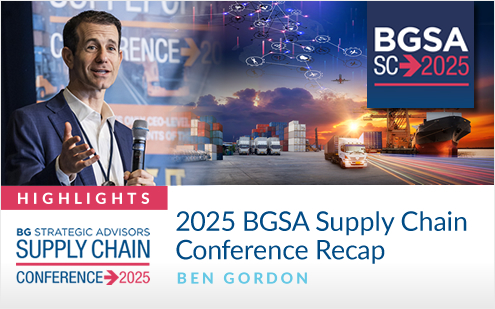
On behalf of all of us at BGSA Holdings and Cambridge Capital, we wanted to share some highlights of BGSA Supply Chain 2025. For those of you who joined us, we hope you had a great time.
For our 19th annual Supply Chain conference, we returned as always to the Breakers in Palm Beach. Although we endured the coldest week in our two-decade history, we enjoyed the warmth of a truly special supply chain community, and hosted an all-time high of 380 CEOs and leaders across all areas of the supply chain ecosystem.
This record turnout included CEOs from North America, South America, Europe, Asia and Africa. We got to exchange ideas with leaders in logistics, distribution, freight forwarding, truck brokerage, warehousing, trucking, shipping, last mile, fulfillment, and other areas. As technology has become more and more embedded in the supply chain, we met with software all-stars in WMS, TMS, reverse logistics, predictive pricing, digital brokerage, and a host of ecommerce logistics categories. And we got to talk with over 30 of the top supply chain CEOs about their outlook for 2025. This was truly a "Davos for Logistics" week!
State of the Supply Chain Markets
In 2025, we believe we are about to enter the fourth major wave of change in the modern supply chain world. The first wave began in 1956, when Malcom McLean invented the modern shipping container. The second wave emerged in 1980, when the Motor Carrier Act ushered in an era of deregulation, outsourcing, and competition. The third wave developed in 1997, when Amazon went public and the Internet age began.
Many people thought a fourth wave began in 2020, when COVID shortages caused companies to rethink their supply chains. In fact, the opposite occurred. From January 2022 to April 2024, we witnessed the worst freight recession of our lifetimes. Freight rates plunged by 50% from their peak. Transportation volumes dropped by 20%. And we saw record bankruptcies, punctuated by Yellow and Convoy.
Meanwhile, volatility has erupted throughout the world, rippling through supply chains: Russia's invasion of Ukraine has cost the world economy over $1.6 trillion; the Red Sea Crisis forced shipping delays of 10-14 days, a 35% increase in lead times, and over $40 billion in freight disruptions; the Panama Canal drought slashed daily ship crossings by 33%; ILA strike threats caused a 12% surge in inventory stockpiling; and tariff expansion continues, including increases on US-China tariffs and proposals for 25% tariffs on Canada and Mexico.
So what is next? We believe 2025 will usher in a fourth great cycle: the pendulum will swing back from long-range globalization to compressed supply chains. In just two years, manufacturing construction spending in the U.S. has increased 86%, to $237 billion — with major reshoring investments from General Motors, Intel, GE Appliances, Harley-Davidson, Micron Technology, and Panasonic Energy.
When we look at 2024's winners in market value, two standouts jump out. First, global trade management software leaders WiseTech and Descartes continued their success — WiseTech soared 47%, gaining $8.0 billion of value, and Descartes added 40%. Second, domestic supply chain companies Universal and XPO were the two highest growing companies in stock price performance, up 62% and 56% respectively.
The Outlook for 2025
As we begin the fourth wave of compressed supply chains, six key themes emerge:
1. Freight companies that invest in the early innings of the great American freight recovery — the US freight recession is officially over, with spot rates up 17% from the April 2024 bottom and forecasts of a 30-50% increase in 2025
2. Domestic supply chain leaders that can accelerate their growth as companies relocate manufacturing closer to home, with particularly strong growth in the South and Midwest
3. E-commerce logistics companies that can help consumers improve their buying experience — Amazon has grown its North American fulfillment footprint 7x in 8 years, and new giants like Temu are emerging
4. Companies that can help their clients navigate complex global trade amidst record volatility — an arena increasingly dominated by the Descartes-WiseTech duopoly, together worth $35 billion
5. Fast followers that can adopt technology and deploy it as a competitive weapon — companies that view transportation as a competitive weapon are 3.4x more likely to be top financial performers
6. AI providers that can aggregate the most data and deliver superior value — with applied AI winners like Greenscreens.ai in predictive pricing, HappyRobot in call automation, Levity in email, and Waymo in driverless trucking
The Capital Markets
We believe 2025 will be a record year for M&A after a three-year lull. The bid-ask gap that follows every recession is narrowing now. Global giants are divesting to focus on their core — UPS sold Coyote Logistics to RXO, FedEx announced plans to spin off its LTL business, and TransForce announced intentions to separate into two pure-plays. Consolidators like RXO, Descartes, WiseTech, TFI, and CMA CGM are doubling down — and the top 10 players still own just 41% of the fragmented brokerage market. The smartest buyers seek strategic differentiation: consumers returned 17% of purchases last year ($890 billion, double from 5 years ago), driving deals like UPS-Happy Returns and DHL-Inmar Intelligence.
Our Point of View at BGSA and Cambridge
Our M&A advisory firm, BGSA, has worked on over 50 transactions in the sector over the past 20 years, with clients including YRCW, NFI, GENCO (now FedEx), New Breed (now XPO), and many others. Six engagements are currently under way.
Our affiliated private equity firm, Cambridge Capital, continues to invest in outstanding platforms in the logistics and supply chain technology arena, focusing on $10-$50 million checks. Portfolio companies include Greenscreens.ai (grown nearly 10x over 3 years, serving over 200 of the top 300 freight brokers), Parcel Perform, Bringg, ReverseLogix, Everest, byrd, Liftit, DeliveryCircle, and STAT Recovery.
Closing Thoughts
In sum, we thank you for being a part of the BGSA Supply Chain ecosystem. We all learn and benefit from the collective wisdom of this outstanding network of CEOs and industry leaders. Please save the date for next year's BGSA Supply Chain Conference: January 21-23, 2026, when we will again return to the Breakers in Palm Beach for our 20th annual conference!
Thank you and best wishes for the coming year.
Benjamin Gordon
Managing Partner, Cambridge Capital
This story was published by an outside outlet.
Read the full article