
Dear Friends,
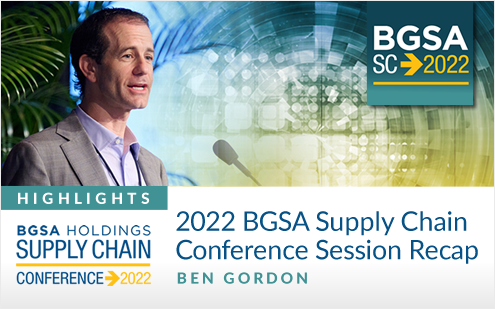
On behalf of all of us at BGSA Holdings and Cambridge Capital, we wanted to share some highlights of BGSA Supply Chain 2022. For those of you who joined us, we hope you had a great time.
This was a unique experience. For our 16th annual Supply Chain conference, we overcame the obstacles of COVID-19 and returned to our first in-person meeting since 2 years ago. Together, we were able to join with over 300 CEOs and leaders across all areas of the supply chain sector.
What Did We Learn?
2021 was the year the world discovered the importance of the supply chain. Headlines illustrated the point: "The World Is Still Short of Everything. Get Used to It." (New York Times); "Big business bosses are warning that supply chain issues and inflation are here to stay" (CNBC); "How a perfect storm of factors led to 'the mother of all supply chain disruptions'" (Penn Today); "Economists see supply constraints, labor shortages as bigger risks to economy than Covid-19" (Wall Street Journal).
From the outside, it appeared that the supply chain was broken. Ocean rates shot up from $3,000 to $20,000 per FEU. Congested ports drove delays, as China-US end-to-end transit time doubled from 40 to 80 days. Shortages rippled through the economy — five of Ford's top ten car models faced major delays, and GM's CEO said the semiconductor shortage could cost GM $2 billion in lost earnings.
Given these challenges, you might expect supply chain companies to falter. Instead, they had a record 2021. At BGSA, we track the BGSA Supply Chain Index, a basket of 60 companies across nine segments, including logistics, trucking, rail, and supply chain technology. In aggregate, the Supply Chain Index increased 28% in 2021, and all nine segments produced a positive return.
How do we explain the fact that supply chain challenges have never been more evident, and yet supply chain companies performed so well? We see four key issues:
1. Capacity crunch and low-cost networks. We are in the midst of a record shortage of capacity. Inventory-to-sales is at an all-time low, a function of the rise of "just-in-time" supply chain strategies. This lean strategy saved the US consumer a tremendous amount of money — 40 years ago, supply chain expenses represented 15% of GDP; today, just 7.4%. But that benefit came with a risk: shortages. As capacity tightened, asset-based companies benefited. Less-than-truckload companies as a category shot up 96% in value — 3 of the 5 publicly-traded LTL carriers spiked over 100%, including Yellow (up 186%), ArcBest (up 178%), and TFI (up 119%). The number one overall performer was truckload carrier PAM, which grew 204%. And XPO Logistics added $11 billion, growing its enterprise value from $15 billion to $26 billion.
2. Volatility surge. From 2010 through 2020, freight rates typically changed no more than 10% per year. In 2021, rates shot upward rapidly and violently, reaching nearly 27%. These cost shocks rippled through the supply chain, delivering record profits to asset-based carriers while fueling 6.8% inflation.
3. eCommerce. Consumer behavior shifted suddenly — COVID compressed 10 years of forecasted ecommerce penetration into 3 months. The ecommerce boom caused a surge in last-mile software, in-market real estate, reverse logistics, and supply chain visibility.
4. Innovation. In the last 5 years, supply chain technology investment shot up 4x, from $6 billion to $24 billion. In the last year alone, the number of supply chain unicorns more than doubled, from 25 to 51. Supply chain software was the second-highest performing public category in 2021, generating 60% growth — PFSweb and WiseTech increased 98% and 82%, respectively.
Meanwhile, corporate acquirors stepped up: 2021 saw record levels of M&A, in five categories: consolidators buying competitors (LaserShip-OnTrac); ecommerce companies moving into logistics (Uber Freight-Transplace); logistics companies expanding in ecommerce (Maersk-Visible SCM); infrastructure giants moving into services (PSA-BDP, DP World-Syncreon and Imperial Logistics); and retailers taking control of their supply chain (American Eagle Outfitters-Quiet Logistics and Airterra).
Perspective at Cambridge Capital
At Cambridge Capital, we believe we are in the early innings of a transformation in high-growth digital supply chains. Key themes include last-mile logistics, AI to automate supply chains, supply chain visibility, reverse logistics, and tech-enabled "man + machine" services. Recent investments include Bringg (last-mile logistics SaaS — backed since 2016 and now one of the latest unicorns in logistics), ReverseLogix (the first true end-to-end returns management system), Parcel Perform (supply chain visibility, backed along with Softbank), and Everest (tech-enabled truck brokerage growing rapidly with blue-chip CPG companies). We have a simple philosophy: back outstanding CEOs who are building top-quality businesses in the supply chain arena, on a majority or minority basis, with $10-$50 million checks.
Perspective at BGSA
On the advisory side, BGSA continues to expand its M&A services. BGSA has earned a reputation as a leader in M&A for transportation, logistics, and supply chain services, and has worked on over 50 transactions in the sector. Clients and transactions have included NFI, C.R. England, GENCO (now FedEx), New Breed (now XPO), and many others. Just this week, BGSA's client Werner Enterprises announced the sale of Werner Global Logistics to Scan Global Logistics Group.
Closing Thoughts
In sum, we thank you for being a part of the BGSA Supply Chain ecosystem. We all learn and benefit from the collective wisdom of this outstanding network of CEOs and industry leaders. Please save the date for next year's BGSA Supply Chain Conference: January 18-20, 2023, when we will again return to the Breakers in Palm Beach for our 17th annual conference!
Thank you and best wishes for the coming year.
Sincerely,
Benjamin Gordon
This story was published by an outside outlet.
Read the full article